

Shop All


Matching Neck Finishes
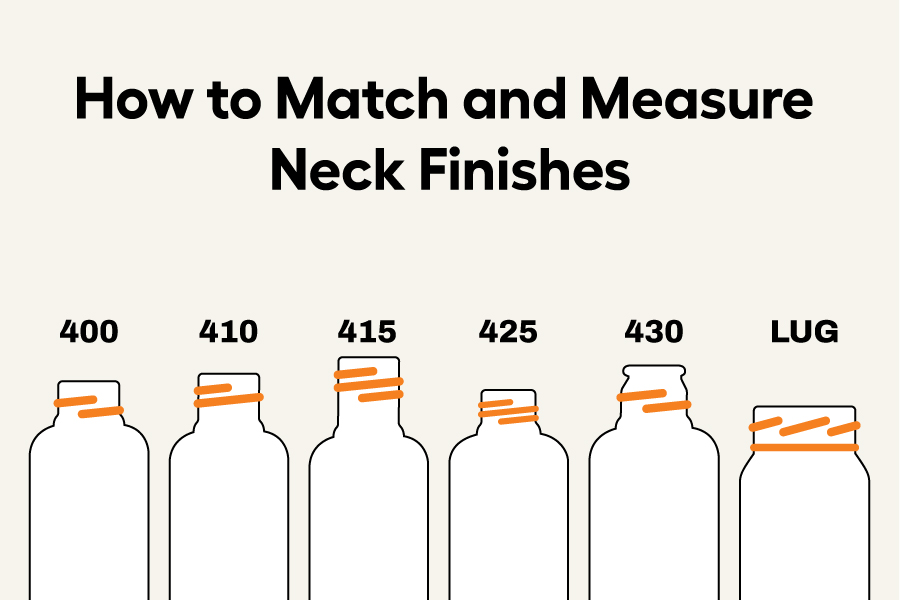

You spent a non-trivial amount of time finding the right container for your product. Good shape, right size, looks exactly how you imagined it on your shelf. You’re ready to order. Then the listing mentions a neck finish, and suddenly you’re staring at something like 24-410 wondering if you accidentally wandered into a hardware catalog.
You didn’t. And it’s not as complicated as it looks. But it does matter, because the wrong lid means a cap that wobbles, leaks, or refuses to close.
Here’s how the whole “neck finish” thing works.
What is a Neck Finish?
A neck finish is just the opening of your container, defined by its diameter, height, and thread style. Those three things together determine which lids will fit properly. (If you want the rest of the anatomy lesson, Bottle Body Parts walks through everything from the orifice down.)
The code you see in product listings (like 24-410 or 18-400) is a shorthand for those measurements:
- The first number is the diameter across the outside of the threads, in millimeters
- The second number describes the thread style and how many times the threads wrap around the neck
A 24-410 container needs a 24-410 lid. This isn’t a case of “oh well close enough.” They need to be the same number.
Three Types of Threads: Continuous, Lug, and Triple

Before you measure anything, it helps to know which of two basic thread categories you’re working with.
Continuous thread (CT) is the classic screw-on lid, featuring one long thread that spirals around the opening. This will be on your peanut butter jar or your morning juice bottle. You’ve been using these your whole life; you just didn’t know what they were called. Now you do. What a momentous occasion. The thread style is indicated by the three-digit code (400, 410, etc.).
Continuous thread closures come in plastic and metal. Plastic caps usually have a ribbed or smooth skirt (the ribs are there for grip, which your hands will appreciate somewhere around bottle number 300 of a fill day), and metal lids typically carry a plastisol liner that seals against the rim of a glass jar. How far you twist depends on that second number: a 400 is about one full turn, a 410 about a turn and a half, and a 415 two or more. So a 24-400 and a 24-410 share a diameter but not a thread, which is why they aren’t interchangeable. You’ll find metal CT lids under Metal Caps and plastic ones under Non-Dispensing Caps.
Lug or twist finish (TW) has multiple short threads that only go partway around, and the lid snaps shut in about a quarter turn. There’s a small latch that holds under pressure. Think jam and pickle jars. Lug finishes are marked TW in the neck finish code, they’re not compatible with continuous thread containers, so it’s worth knowing which one you have before you start comparing lids.
Lug caps are metal, usually lined with plastisol, and they’re the standard closure for home canning and preserved foods (that pop when you open a jar of salsa is the vacuum seal letting go). We carry lug and twist caps in 43TW, 58TW, 63TW, 70TW and 82TW, and if you’re choosing between liner types, 3 Types of Plastisol Canning Caps covers the differences.
Triple thread (TT) is a continuous thread with three starting points instead of one. The cap grabs the neck in three places at once and travels three times as far with each turn, so a wide lid seals with a lot less twisting. That’s why you’ll mostly see it on big canisters and wide-mouth containers for powders and cleansers, the kind of thing that gets opened every single day.
On our site it shows up as 120TT. Canisters like the 85 oz B500 take 120mm triple thread lids like the L259. We also carry 120-400 jars, and even though both say 120, each one has its own set of lids. The Matching Items section on the product page will keep you from mixing them up.
How to Measure Your Neck Finish

Grab calipers if you have them (they’re about $10 and genuinely useful if packaging is now part of your life). A ruler works too. If you’re feeling adventurous, you can print our Neck Finish Measurement tool here. Make sure to print at 100% scale, cut the red outline, and tape the two halves together. It works, just don’t plan on showing it off at any craft fairs.
To measure your container: measure from the outermost edge of one thread, straight across through the middle, to the outermost edge on the other side. Include the threads, don’t just measure the hole in the center. That part trips people up.
To measure your lid: measure from inner wall to inner wall. Not the outside of the cap, the inside.
Either way, your number is in millimeters. That’s the first number in your neck finish code. In the example above, it would represent the 28 in 28-410.
Identifying the Style and Threads
Next, take note of the thread style and how many times the threads pass one another to determine the last number (or letters) in your “Neck finish.”
- Example one: 28mm measurement of the lid and container and 1.5 thread turn, equals 28-410 Neck Finish
- Example two: 70mm measurement of the lid and container with a LUG turn (.25 of a full turn), equals 70TW Neck Finish
- Example three: 120mm measurement of the lid and container with three separate thread starts, equals 120TT Neck Finish
Below is a list of the common neck finish threading styles.
| Thread turn | Code |
| 1 full turn | 400 |
| 1.5 turns | 410 |
| 2 turns (tall) | 415 |
| 2 turns (narrow) | 425 |
| Thick / buttress threads | 430 |
| Lug / twist finish (not continuous thread) | TW |
| Triple thread (three thread starts) | TT |
Put it together: a container that measures 28mm across with threads that wrap 1.5 times is a 28-410 neck finish. A 70mm lug finish is 70TW. The system is actually pretty logical once they’re able to be deciphered.
Lids That Don’t Use a Neck Finish Code

Some containers skip the numbering system entirely, which is good to know before you spend ten minutes hunting a product page for a code that was never there.
Slip cover lids (also called friction fit lids) are what you’ll find on most metal tins. There are no threads at all: the lid slides down over the rim and stays put through friction. They’re a good fit for solids like candles, lip balm, salve and wax, but they aren’t airtight or spill-resistant, so anything liquid belongs in a different container. Our shallow tins and deep tins come with their lids already matched (a few of the shallow ones are screw-top instead), so the only thing you’re choosing is the tin size. If you’re still deciding whether metal is right for your product, The Pros and Cons of Packaging with Metal Containers is a good next read.
Snap-on tub lids press down over the tub’s rim and click into place, no twisting involved. They’re made for products that get opened and closed constantly, like body butter, protein powder and pet food. Tub lids are sized by diameter in inches instead of a neck finish code (one of ours is 3.5625 inches across, so somebody in the tub business really loves sixteenths). The easiest way to match one is the Matching Items section on the tub’s product page.
Time to Say Goodbye
If your container is already on containerandpackaging.com, there’s an easier path: look for the Matching Items section on the product page. Every container shows its compatible closures directly, no math required.
And take advantage of our sample program. You can order up to 10 different lids or containers to test-fit before you commit to a full run. Getting it right at the sample stage costs you almost nothing. Getting it wrong at 500 units is how core memories are made.
This will most definitely shock you: a blog post on containerandpackaging.com is suggesting you shop at containerandpackaging.com. Take a moment. Then go find your lid, we’ve got a lot of them.
Questions? A real human is standing by: (800) 473-4144
Amber Glass
Articles
Blog
Bottles
Caps, Closures & Dispensing
Closures
Container Updates
Cosmetics and Beauty
Customer Stories
Environmental Impact
Food and Beverage
Glass Bottles
Glass Jars
Glass Packaging
Guide
Guides
Health and Pharmaceutical
Infographic
Infographics
Mason Jars
Metal Containers
Oils and Aromas
Packaging Design
Plastic Bottles
Plastics
Sustainable Packaging
The Fun Stuff
Trends and Technology
Uncategorized
Videos


